AI agentssystems designengineering leadershipsoftware deliveryproductivity
The 100x Agent Illusion Is a Systems Problem
Agents can increase output dramatically, but they cannot rescue broken data, unclear workflows, weak ownership, or review bottlenecks. The system has to be engineered first.
The 100x Agent Illusion Is a Systems Problem
The fantasy of the 100x agent is seductive because it preserves a familiar management dream: buy a capability, point it at work, and watch output explode.
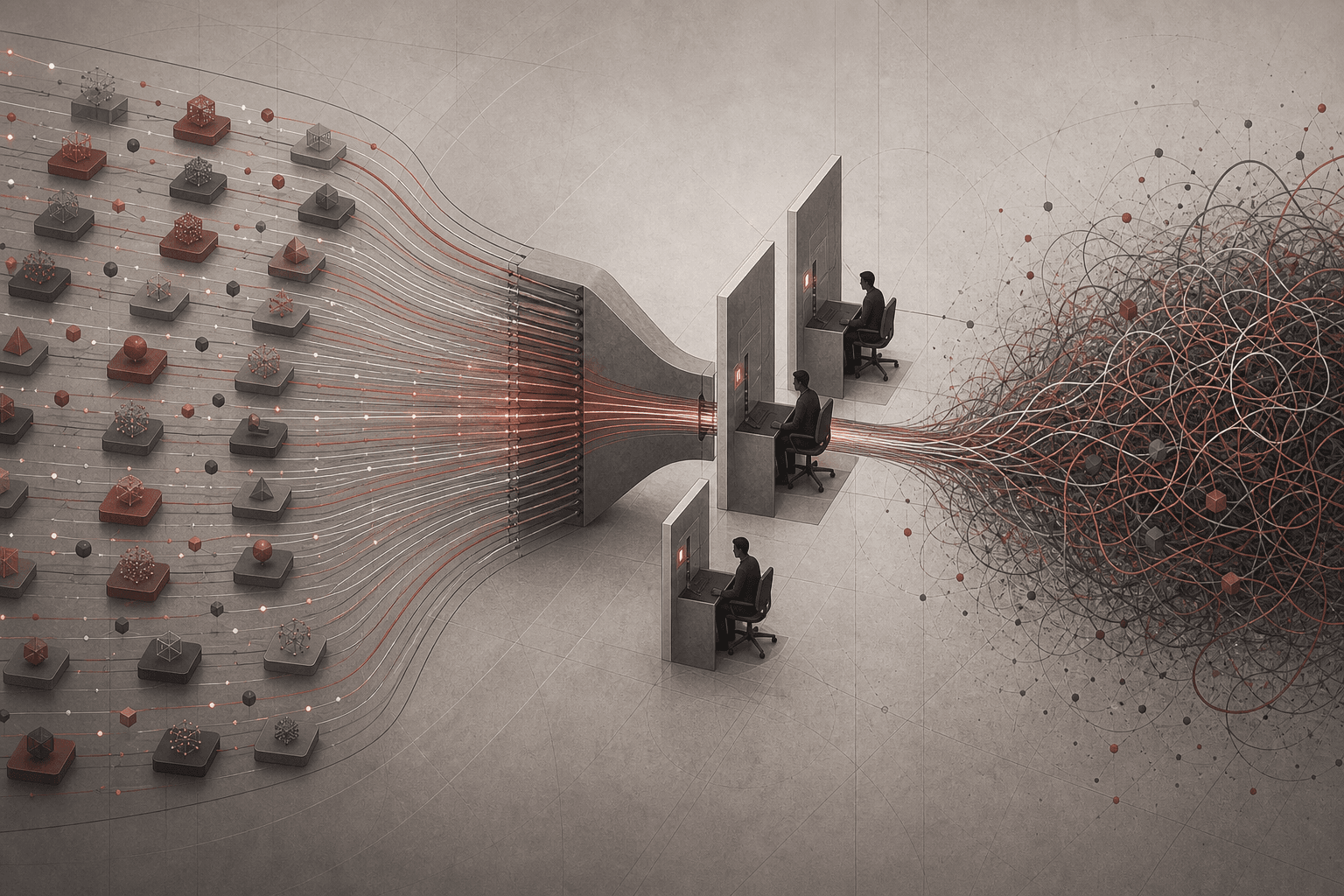
But output is not the same as throughput.
that companies are layering agents on top of broken data, messy schemas, and undefined workflows. His central warning is right: if the surrounding system cannot absorb, review, govern, and ship the work, agent productivity becomes a multiplier for dysfunction.
This is the part many executive AI plans still understate.
Agents do not remove the need for system design.
They punish its absence.
Faster Generation Exposes Slower Organizations
Most organizations are not bottlenecked only by typing speed, coding speed, research speed, or drafting speed.
They are bottlenecked by unclear ownership, inconsistent data, overloaded reviewers, brittle processes, slow approvals, and weak feedback loops.
When AI accelerates one part of that chain, the bottleneck does not disappear. It moves.
If agents write more code than humans can review, the bottleneck becomes review quality. If agents generate more analysis than leaders can interpret, the bottleneck becomes decision discipline. If agents automate workflows that were never clearly defined, the bottleneck becomes operational ambiguity.
The company then mistakes activity for progress.
The Review Bottleneck Is Not a Staffing Problem
The instinctive response is to add reviewers.
That helps only briefly.
The deeper question is what should require review at all. High-risk changes need human attention. Routine low-risk actions need tests, policy, and automated checks. Repeated work needs reusable patterns. Decisions need thresholds. Evidence needs to be captured as work happens, not reconstructed afterward.
Otherwise, humans become the cleanup layer for machine output.
That is a demoralizing and expensive operating model.
Determinism Still Matters
One of the strongest points in the APILama piece is that business logic cannot simply be replaced by model intuition.
LLMs are powerful at language, pattern recognition, code generation, summarization, and tool use. They are not a substitute for explicit rules where the business requires determinism.
Order fulfillment, eligibility checks, financial controls, regulatory obligations, identity permissions, and irreversible actions need defined rails. Agents can operate inside those rails. They can help build, test, explain, and improve them. But the rails need to exist.
The future is not probabilistic everything.
It is probabilistic intelligence wrapped in deterministic control.
The System to Engineer
Before asking whether agents can produce 100x more work, leaders should ask whether the organization can safely convert agent output into value.
That requires five system capabilities:
clean enough data for agents to reason from,
explicit workflows agents can operate within,
deterministic policies for high-stakes actions,
evaluation loops that detect bad output before it spreads,
and human review focused on judgment, not clerical checking.
This is why the best AI programs often look less glamorous than demos.
They spend time on schemas, permission models, workflow definitions, test cases, observability, and review protocols.
That is not bureaucracy. It is leverage.
Where Gaia Fits
Gaia is built for the less glamorous but more important layer: turning agents into an operable enterprise capability. Conversations, workflows, evaluations, governance, documents, and delivery evidence need to remain connected so agent output can become trusted work.
The useful next reads are the , , and . They are more relevant than another demo when the real problem is converting AI capability into governed execution.
Practical Takeaway
Before deploying an agent into any workflow, run a systems audit:
Is the workflow defined?
Is the data owned and current?
Are allowed and prohibited actions explicit?
Are tests or evaluations available?
Is human review reserved for real judgment?
Can every action be traced and reversed where needed?
If the answer is no, the agent will not make the system 100x better.
It will make the system's weaknesses 100x more visible.
About the author
Kostas Karolemeas
Product and Technology Lead of Gaia, two-time founder, and software product executive with more than three decades of experience building and scaling products across healthcare, architectural and mechanical engineering software, logistics and supply chain, financial services and banking, enterprise resource planning (ERP), and visual effects (VFX) for television.