Forward-Deployed AI Is a Feedback Loop, Not a Services Motion
Forward-deployed engineering is becoming central to enterprise AI because agents change with models, workflows, and customer practice. The real advantage is the learning loop between deployment and product.
Forward-Deployed AI Is a Feedback Loop, Not a Services Motion
The forward-deployed engineering conversation is about to get noisy.
That is mostly good. It is also easy to misunderstand.
, argued in a recent that AI is not adopted like conventional software. Traditional software can often be implemented as a stable artifact. AI systems, especially agentic systems, change as models improve, as best practices mature, and as workflows are redesigned around capabilities that did not exist a quarter earlier.
That distinction is right.
But the important conclusion is not simply that vendors need more people in the field.
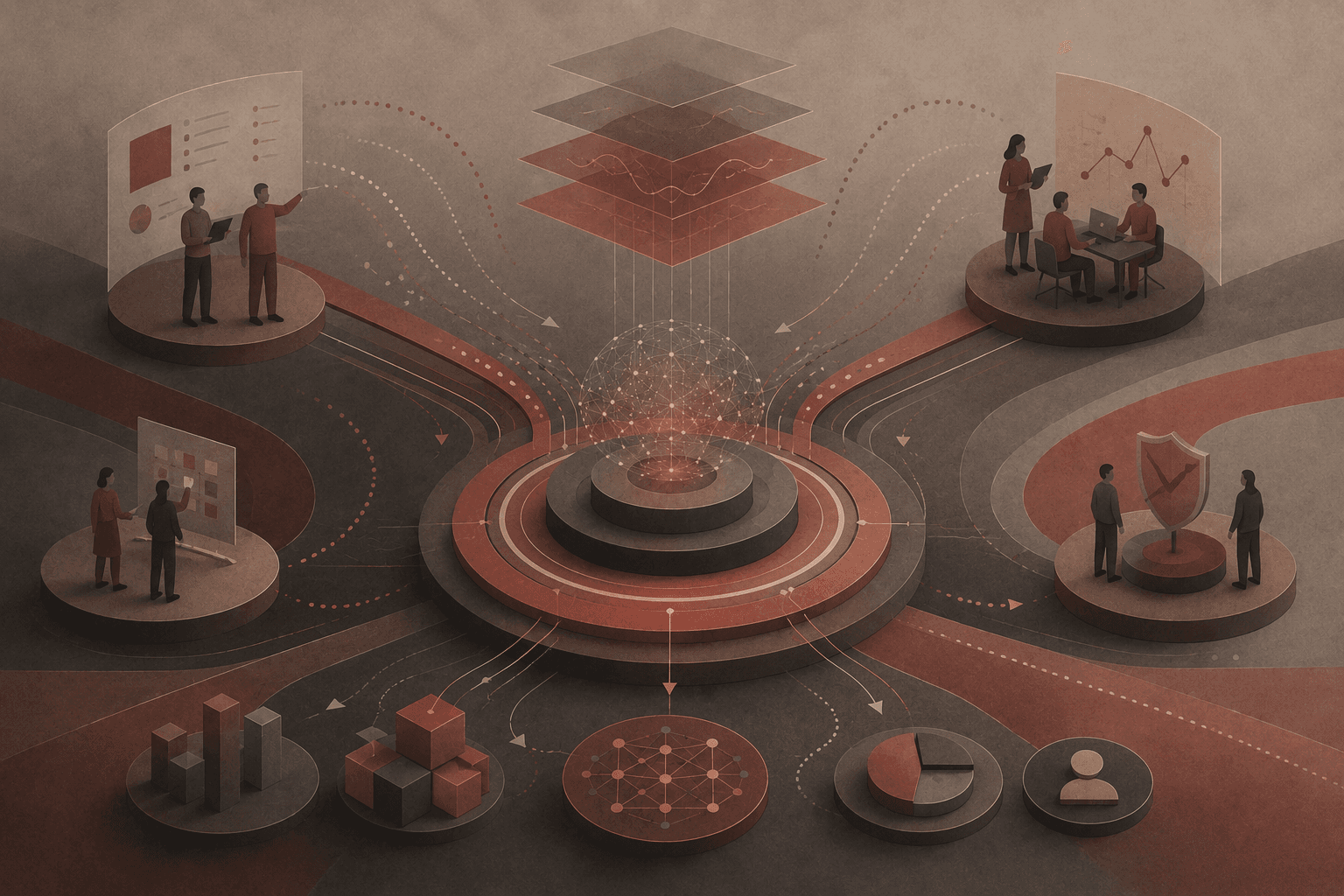
The important conclusion is that enterprise AI needs a tighter learning loop between field deployment, customer practice, product design, governance, and model evolution.
Forward-deployed engineering is one form of that loop.
Software Adoption Assumed Stability
Most enterprise software implementation models were built around relative stability.
A vendor shipped a system. The customer configured it, trained users, migrated data, managed change, and refined process over time. The software improved through releases, but the core adoption model assumed that the customer was implementing something with reasonably stable behavior.
Documentation made sense in that world. Training made sense. Certification made sense. Standard implementation phases made sense.
The product was not static, but it was legible enough that adoption could be planned around known functionality.
AI breaks part of that assumption.
The same workflow may behave differently when the model improves, when retrieval gets better, when tool use becomes more reliable, when context windows expand, when reasoning patterns change, or when evaluation exposes a failure mode that was previously invisible.
That does not mean AI is unmanageable.
It means the management model has to change.
Model Progress Changes the Workflow
In conventional software, a product upgrade usually adds features, fixes defects, or improves performance. In AI, a model upgrade can change what work is worth automating.
A workflow that required five human review steps last quarter may require two after a model improvement. A use case that was too brittle in January may become production-worthy in April. A support agent that was acceptable only for internal drafting may become reliable enough for supervised customer response after retrieval, tool policy, and model quality improve together.
This is why Levie's point matters. Customers cannot be expected to discover every step-function improvement alone.
The hard part is not reading release notes. The hard part is knowing which operational assumptions should be revisited when capability changes.
Should the approval threshold move?
Should the human role shift from drafting to exception review?
Should an agent get access to another tool?
Should the workflow be collapsed, split, or instrumented differently?
Those are not generic documentation questions. They are situated engineering and operating questions.
The Field Is Where Patterns Become Real
Forward-deployed engineering is valuable because the field contains information the product roadmap cannot infer from telemetry alone.
Usage data can show that people clicked a feature. It cannot fully explain why a workflow stalled, why a policy owner refused approval, why a data boundary mattered, why a team ignored an agent, or why a technically correct automation created operational anxiety.
The field reveals the shape of real work:
- which systems of record actually matter,
- where policy and process diverge,
- which exceptions are common enough to design for,
- which controls create confidence,
- which metrics prove business value,
- and where users still need human judgment.
This is why as work inside complex enterprise environments where security models, permissions, governance, compliance, operational controls, and legacy infrastructure are not edge cases. The lesson is broader than OpenAI. The field is where AI stops being a capability and becomes an operating system.
Vendor Learning Must Flow Back Into Product
The strongest version of forward deployment is not custom services forever.
It is build, prove, generalize.
If every customer deployment becomes bespoke craft, the model does not scale. The vendor learns, but the product does not improve fast enough. Customers get high-touch delivery, but they may also inherit fragile one-off patterns.
The better loop is different:
- Solve a concrete customer problem.
- Identify the repeatable pattern.
- Turn the pattern into product capability.
- Update implementation guidance.
- Reuse the improved product and playbook with the next customer.
That loop is why the FDE motion matters. It converts field reality into product evolution.
It also explains why large services organizations are moving in the same direction. framed around designing, building, and operationalizing AI across the enterprise. similarly emphasizes high-impact business problems, measurable criteria, and outcome-focused teams.
The market signal is clear: AI adoption is becoming an engineering motion close to the work.
Customers Still Need Internal Ownership
There is a trap in the FDE narrative.
If vendors know the patterns, customers may conclude that the vendor should own the implementation intelligence.
That is dangerous.
Vendors can spread best practices faster across customers. They can see recurring failure modes. They can productize what works. They can bring model-specific and platform-specific expertise that most customers cannot maintain internally.
But customers still own the business process, risk appetite, data boundaries, workforce changes, operating metrics, and consequences of deployment.
Forward deployment should not become dependency theater.
The best customers use vendor field expertise to accelerate their own capability. They build internal counterparts who understand process, governance, data access, evaluation, and change management. They do not outsource judgment. They use the vendor to learn faster.
This is especially important for agents.
An agentic workflow touches permissions, tools, evidence, approvals, escalation, rollback, and organizational accountability. A vendor can help design the system. The customer must own the operating model.
The New Adoption Unit Is the Workflow
For chat tools, adoption can be individual. A user learns how to prompt, summarize, draft, and search.
For agentic systems, adoption is organizational.
The unit is no longer the user. The unit is the workflow.
That changes the work:
- The workflow needs an owner.
- The agent needs scoped authority.
- The data boundaries need to be explicit.
- The tool actions need risk classes.
- The human review points need design.
- The evaluation criteria need to match business outcomes.
- The release process needs evidence.
- The improvement loop needs cadence.
This is why forward-deployed engineering, AI automation engineering, and AI operating model design are converging. They are different names for the same pressure: someone has to turn model capability into governed workflow change.
Where Gaia Fits
Gaia is built around this deployment reality. The platform connects agent design, runtime orchestration, document context, workflow graphs, evaluations, governance records, and delivery evidence so teams can keep the field learning loop visible instead of scattering it across slides, tickets, chat threads, and disconnected demos.
The most relevant Gaia resources are the , the , the , and the . The related post on is useful alongside this one because it describes the internal role customers need when vendor field expertise meets production workflow ownership.
Practical Takeaway
Treat forward-deployed AI as a learning architecture, not a staffing trend.
For every important AI workflow, define the loop:
- Field signal: what did the deployment reveal about real work?
- Product signal: what should become reusable capability?
- Governance signal: what controls, evidence, or approvals changed?
- Model signal: what new capability should trigger workflow review?
- Customer ownership: who owns the process after deployment?
- Improvement cadence: when will the workflow be reassessed?
The companies that get this right will not merely adopt AI faster.
They will learn faster than their operating model decays.
About the author
Kostas Karolemeas
Product and Technology Lead of Gaia, two-time founder, and software product executive with more than three decades of experience building and scaling products across healthcare, architectural and mechanical engineering software, logistics and supply chain, financial services and banking, enterprise resource planning (ERP), and visual effects (VFX) for television.