Enterprise AI Diffusion Needs Implementation Labor
Enterprise AI will create far more implementation work than most forecasts assume because agents have to be connected to production systems, governed workflows, access controls, cost policies, and recurring model upgrades.
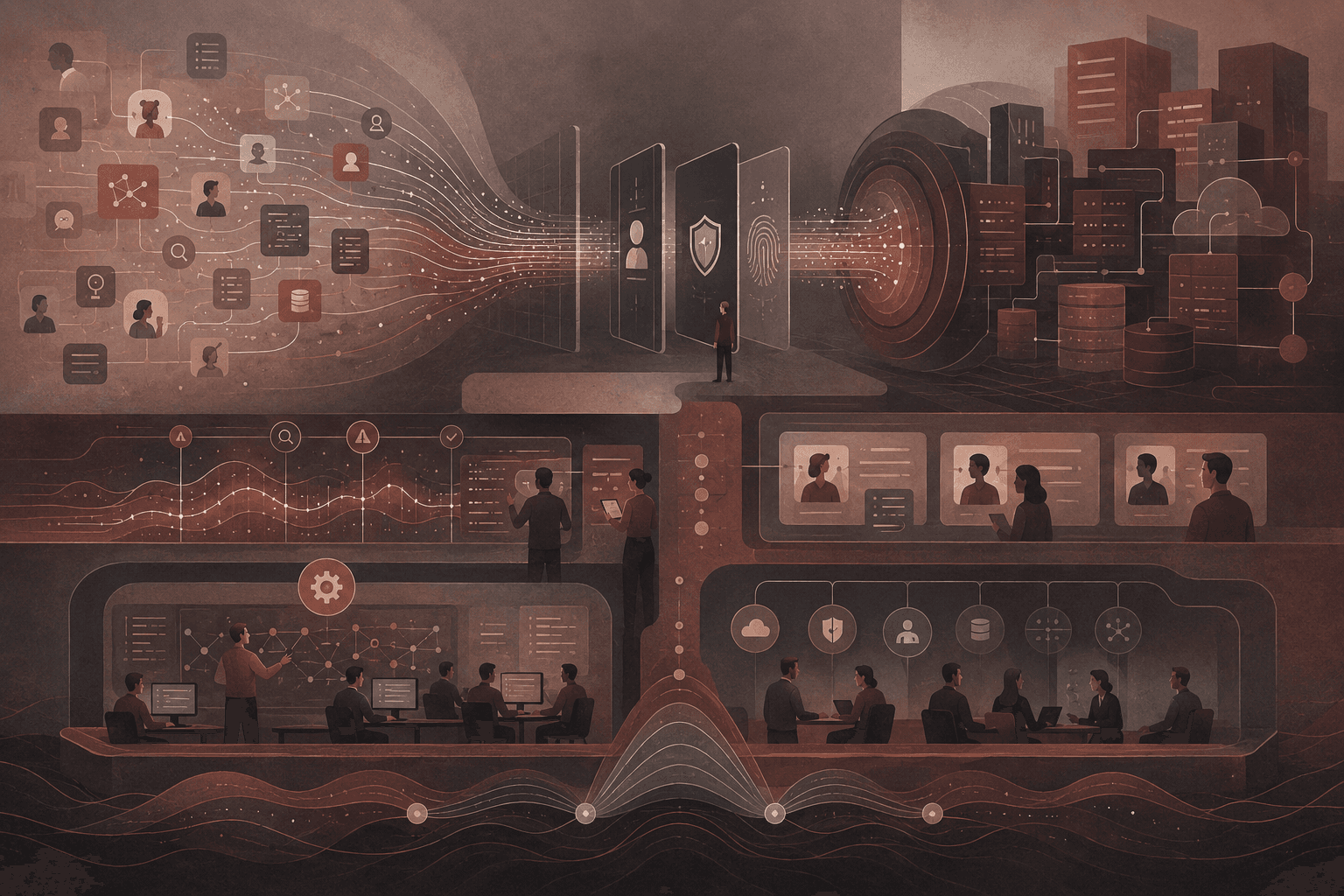
Enterprise AI Diffusion Needs Implementation Labor
The underestimated constraint in enterprise AI is not access to models.
It is the amount of skilled implementation labor required to make those models useful inside real organizations.
that whatever number of people you thought might work on enterprise AI deployment should be multiplied by ten, and then probably by ten again. That sounds exaggerated only if AI adoption is imagined as a software rollout.
It is not.
Enterprise AI adoption is becoming a systems integration, governance, workflow redesign, and operating-model problem. The moment an agent moves beyond search and chat into production work, it collides with permissions, data classification, legacy systems, human approval, auditability, cost control, and organizational change.
That is a lot of work.
And most companies have not staffed for it.
The Chatbot Era Hid the Real Work
The first enterprise AI reference architecture was deceptively simple: connect an LLM to documents, add retrieval, put a chat interface on top, and let employees ask questions.
That pattern created value. It also set expectations too low.
A chatbot can often sit beside the workflow. An agent has to enter it.
Once AI starts updating records, drafting customer-facing outputs, routing exceptions, triggering follow-ups, preparing approvals, or coordinating across tools, the implementation problem changes. The question is no longer whether the model can produce a plausible answer. The question is whether the organization can trust the system to participate in work.
That requires an implementation layer with real authority and real accountability.
It has to decide which systems the agent may touch, which actions are reversible, which decisions require human review, which evidence is preserved, which failures stop the workflow, and which metrics prove the system is improving productivity instead of generating review debt.
This is why the labor market expands.
The work is not just prompt tuning. It is productionization.
Model Progress Makes Deployment Recurring
Traditional enterprise software implementation usually assumes a relatively stable target. The vendor ships a product, the customer configures it, the integrator connects it, and the organization trains users.
AI is different because the capability boundary keeps moving.
A workflow that was too risky for automation in January may become viable by June. A human review checkpoint that was necessary with one model may be excessive after better retrieval, stronger evals, or improved tool use. A high-quality workflow may become too expensive at scale and need model-tier routing. A new model release may make half the previous design obsolete while making the other half more valuable if it is upgraded.
That means AI deployment is not a project with a clean finish line.
It is a continuous operating capability.
This is the part many transformation plans miss. They budget for pilots, platforms, and licenses. They do not budget enough for the recurring labor of revisiting workflows as model capability, cost, and risk change.
The New Role Is Closer to Engineering Than IT Rollout
Levie points to a growing need for the equivalent of internal forward-deployed engineers inside enterprises. That framing is useful because the role sits close to real work.
The person or team doing this job has to understand business process, but also systems. They need enough software judgment to wire production tools safely, enough security judgment to respect access boundaries, enough evaluation judgment to measure quality, and enough organizational judgment to redesign the human workflow.
This looks incrementally closer to software engineering than traditional IT implementation because agents are not passive software seats.
They are semi-autonomous participants in a workflow.
They need scoped authority. They need traces. They need rollback paths. They need tool policies. They need cost budgets. They need quality gates. They need human checkpoints designed into the flow rather than bolted on afterward.
The title may vary:
- AI automation engineer,
- agent operations engineer,
- AI workflow engineer,
- applied AI architect,
- internal forward-deployed engineer,
- or AI implementation lead.
The ownership boundary is what matters.
Someone has to own the chain from workflow intent to system access, runtime behavior, human review, evals, monitoring, and continuous improvement.
If no one owns that chain, the agent remains a demo with enterprise risk attached.
Vendors and Services Firms Will Follow the Same Pressure
This labor market will not exist only inside customers.
AI vendors will need their own applied AI architecture and forward-deployed functions because capability does not adopt itself. The more powerful the platform, the more customers need help translating it into their own operating model. Vendors also have a direct incentive to make deployments work because failed implementation looks like product failure even when the product is not the only problem.
Services firms will grow around the same gap. Enterprises often want a neutral implementation partner that can work across their stack, adapt to their vertical, and manage the messy middle between product capability and operating reality.
That creates room for new AI services firms, new practices inside existing consultancies, vertical specialists, and implementation partners that eventually get acquired by larger platforms.
The market will probably have all three layers at once:
- internal enterprise AI deployment teams,
- vendor-side applied AI and forward-deployed teams,
- independent or consulting-led AI implementation teams.
The successful companies will know how to combine them without outsourcing the core judgment of the business.
Vendors and services firms can accelerate deployment. They should not become the only people who understand why an agent is allowed to act.
The Main Risk Is Industrialized Slop
The ugly failure mode is not that agents do nothing.
The ugly failure mode is that they produce a lot of low-quality work that the organization cannot absorb, review, or trust.
More summaries, more tickets, more follow-ups, more plans, more code, and more analysis are not automatically useful. They can create review debt. They can move labor from creation to cleanup. They can flood already overloaded teams with plausible output that lacks enough evidence, context, or accountability.
That is why implementation labor has to include quality engineering.
Every important agentic workflow needs evaluation criteria tied to the business outcome. It needs observability that shows which tools were called, which sources were used, which policy checks passed, where the system escalated, and what humans changed. It needs cost telemetry so leaders know whether the workflow is economically sane. It needs governance that is fast enough to run with the work rather than after it.
Without that layer, AI does not diffuse into the enterprise.
It leaks into the enterprise.
The Operating Model Comes Before Scale
The practical response is to treat AI deployment as an operating model, not a backlog of use cases.
Before scaling agents, leaders should define:
- Which workflows are worth redesigning around AI.
- Who owns each workflow after launch.
- Which systems and data classes each agent may access.
- Which actions are autonomous, assisted, or prohibited.
- Where human review is required and what evidence reviewers see.
- Which evals define quality for the workflow.
- How traces, incidents, and audit evidence are captured.
- How token cost, latency, and model-tier routing are managed.
- When model upgrades trigger workflow reassessment.
- How lessons from one deployment become reusable patterns.
This is not bureaucracy. It is how organizations convert model progress into repeatable operational progress.
The number of people required will surprise executives because the visible AI layer is deceptively small. The hidden layer is permissions, systems, process, evaluation, review, governance, cost, and change management.
That hidden layer is where diffusion happens.
Where Gaia Fits
Gaia is built around this deployment reality. The platform connects agent design, runtime orchestration, documents, workflow graphs, evaluations, governance evidence, and delivery management so teams can operate agents as long-lived enterprise systems rather than isolated demos.
Useful follow-up resources are the , the , the , and the . The related posts on and are useful companions because this labor-market shift is the organizational version of the same implementation pressure.
Practical Takeaway
If your organization is planning enterprise AI deployment, do not only count models, licenses, use cases, or pilots.
Count the workflows you can responsibly operate.
For each one, assign an owner, map the systems of record, define the allowed actions, design the human checkpoints, write the evals, instrument the traces, track the cost, and set a reassessment cadence for model changes.
AI capability is becoming abundant.
Deployment capacity will be scarce.
About the author
Kostas Karolemeas
Product and Technology Lead of Gaia, two-time founder, and software product executive with more than three decades of experience building and scaling products across healthcare, architectural and mechanical engineering software, logistics and supply chain, financial services and banking, enterprise resource planning (ERP), and visual effects (VFX) for television.