AI transformationenterprise AIoperating modelAI adoptiongovernance
AI Experimentation Is Not Transformation
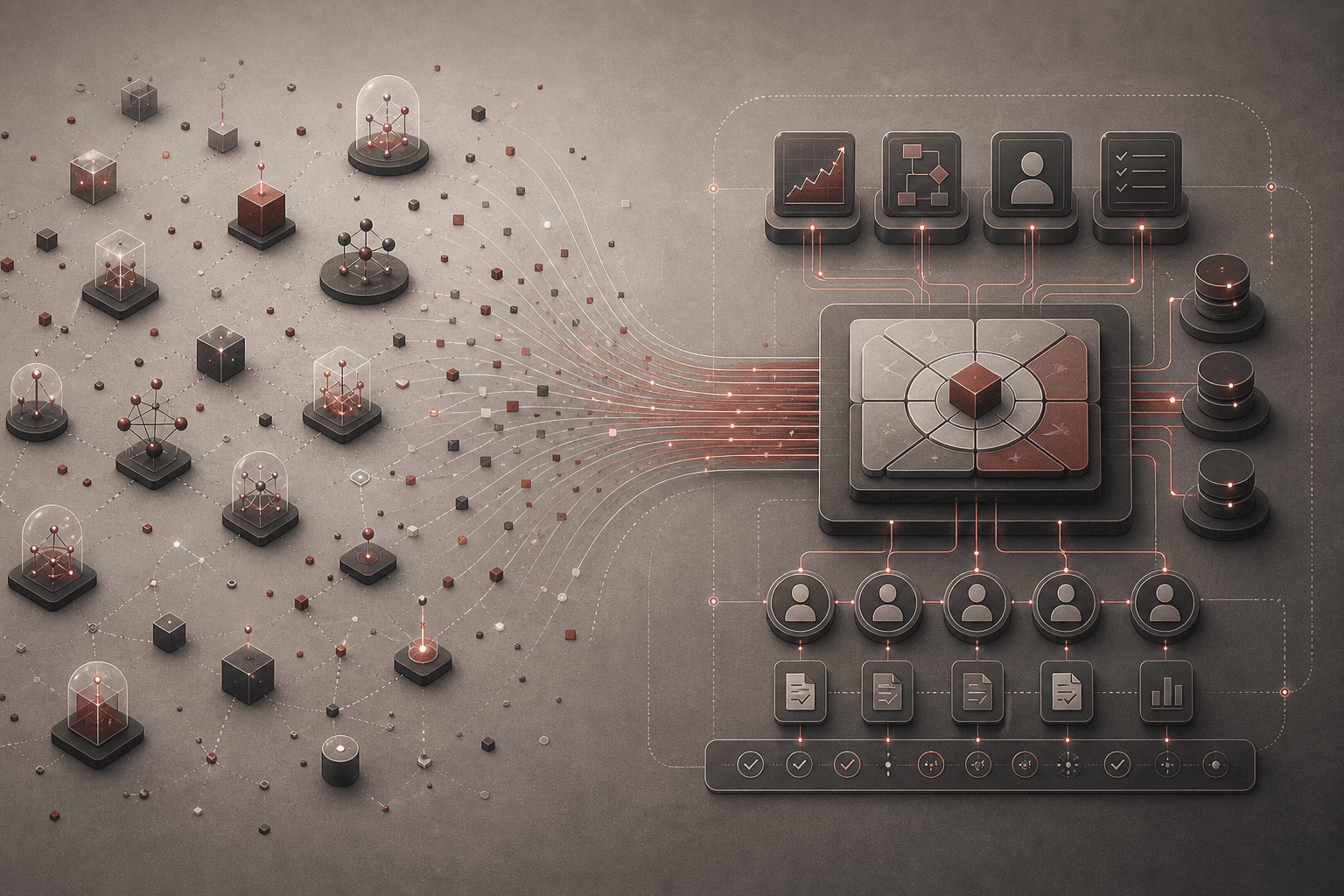
Companies do not become AI-transformed by running more pilots. They transform when AI changes workflows, ownership, metrics, governance, and the operating cadence of the business.
AI Experimentation Is Not Transformation
Most companies do not have an AI transformation problem.
They have an AI experimentation surplus.
Pilots are everywhere. Teams test copilots, build prototypes, run workshops, automate a document flow, generate code, summarize calls, and launch small internal agents. The activity is real. The learning is real. The transformation is often not.
starts from the same gap: generative AI has become a boardroom priority, but adoption does not automatically translate into bottom-line improvement.
That is the point leaders need to internalize.
AI transformation is not measured by how many experiments run.
It is measured by whether the business changes how it operates.
Pilots Avoid the Hard Parts
Pilots are popular because they defer conflict.
A pilot can run without changing ownership. It can avoid production governance. It can use a narrow dataset. It can work around legacy systems. It can report promising results without forcing the organization to redesign incentives, metrics, or process boundaries.
That is why pilots are useful for learning and dangerous as a comfort zone.
At some point, transformation requires the questions pilots avoid:
Who owns the workflow after AI is embedded?
Which steps disappear, change, or become supervised?
What metrics prove business value?
What risk controls are required in production?
What happens to roles when execution becomes faster?
Which systems of record must change?
If those questions remain unanswered, the company has experimentation theater.
Transformation Changes the Workflow
The most important AI work is not adding an assistant to an existing process. It is deciding whether the process should still exist in its current form.
An AI-enhanced workflow may need fewer handoffs, different review thresholds, stronger evidence capture, more automated monitoring, or a new escalation model. It may shift work from production to supervision, from drafting to evaluation, or from manual routing to exception handling.
That is where value appears.
But it is also where organizational resistance appears, because workflow redesign changes power, accountability, staffing, and budgets.
This is why AI transformation is a leadership discipline before it is a tooling discipline.
Metrics Must Move Past Usage
Usage metrics are easy.
How many users tried the tool?
How many prompts were sent?
How many documents were summarized?
How many lines of code were generated?
These are adoption indicators, not transformation indicators.
Better metrics ask whether the operating system of the business improved:
cycle time,
rework,
escalation delay,
error rate,
customer resolution time,
decision latency,
evidence completeness,
policy violation rate,
and recovery time after failure.
If those metrics do not improve, AI is creating activity, not transformation.
Governance Must Scale With the Work
As soon as AI moves from pilot to production, governance has to become operational.
The organization needs data boundaries, agent permissions, model and tool evaluation, logs, ownership, incident response, and lifecycle rules. These controls should not arrive after deployment as a compliance cleanup project. They should shape the production workflow from the beginning.
This is the difference between responsible experimentation and serious transformation.
Experimentation asks, "Can this work?"
Transformation asks, "Can this keep working under real conditions?"
Where Gaia Fits
Gaia is designed for the transition from AI pilots to governed operations. It connects agent design, runtime orchestration, document context, workflow graphs, evaluations, governance records, and delivery evidence so teams can turn AI capability into repeatable production work.
The most relevant resources are the , , , and . They show how transformation becomes concrete through operating surfaces, not just strategy slides.
Practical Takeaway
For every AI pilot, require a transformation brief before scaling:
Workflow change: what changes in the actual process?
Ownership: who owns the new operating result?
Metrics: which business and risk indicators must improve?
Controls: what governance is required in production?
Evidence: what proof will show the system is working?
Sunset rule: when do we stop the pilot if it does not change operations?
Companies do not transform by collecting experiments.
They transform when experiments become new operating defaults.
About the author
Kostas Karolemeas
Product and Technology Lead of Gaia, two-time founder, and software product executive with more than three decades of experience building and scaling products across healthcare, architectural and mechanical engineering software, logistics and supply chain, financial services and banking, enterprise resource planning (ERP), and visual effects (VFX) for television.