AI Automation Engineering Is the Role Enterprises Were Missing
Enterprise agents will not transform business processes as a side project. Companies need AI automation engineers who can turn models, data, tools, controls, and human workflows into production systems.
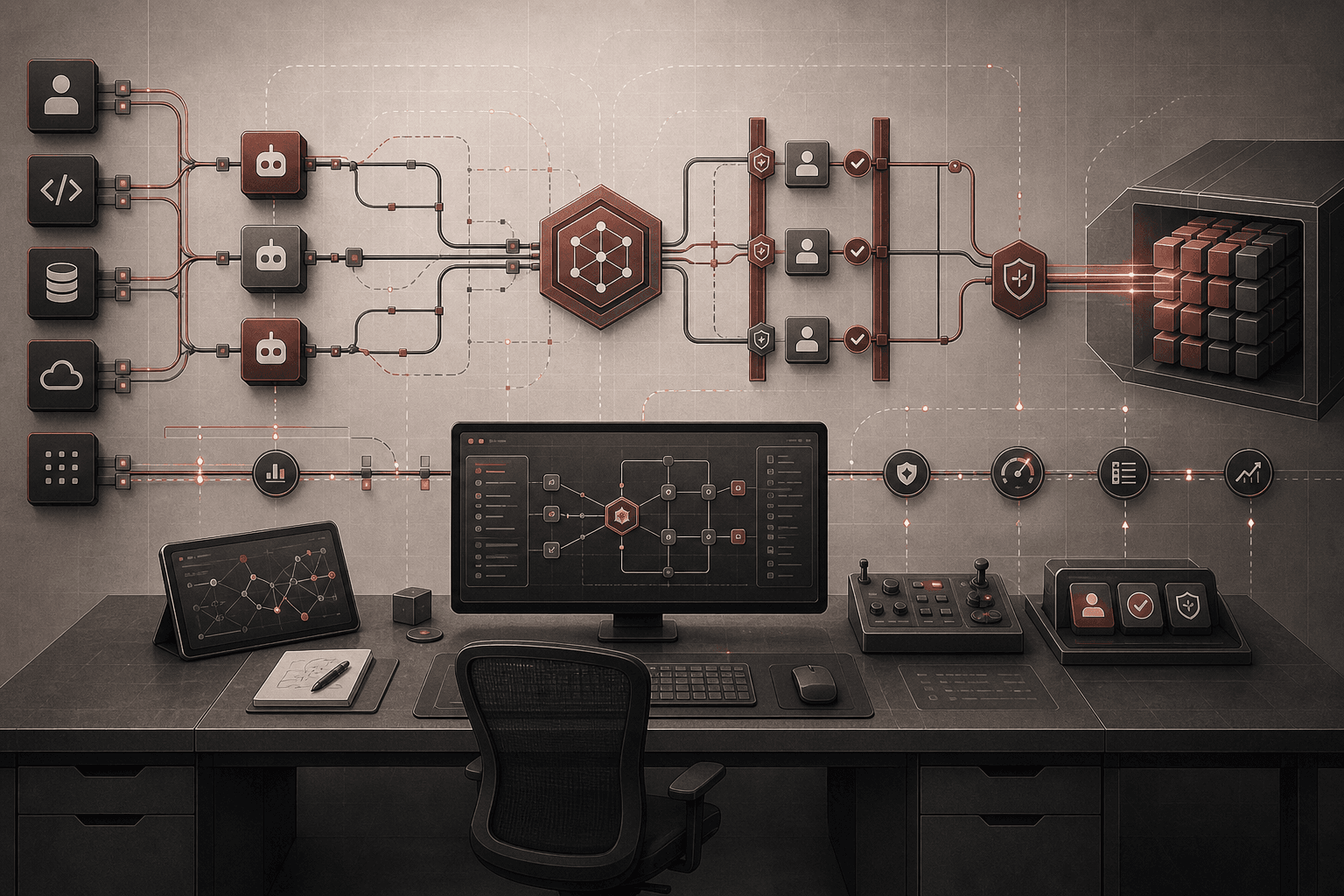
AI Automation Engineering Is the Role Enterprises Were Missing
The most important AI job in many companies will not be prompt engineer, model researcher, or chatbot product manager.
It will be the person who can turn agents into production workflow.
, made this point directly in a recent : Box is hiring for AI automation engineering roles because implementing agents that transform business processes takes real technical work.
That framing is exactly right.
Enterprise agents do not become useful because someone wires a model to a tool and gives it an ambitious name. They become useful when context, data, permissions, system integrations, evaluation, human review, and operating ownership all fit together.
That is engineering work. It is also business design work.
Agents Need More Than Model Access
The easiest part of enterprise AI is getting a model to produce something plausible.
The hard part is making that output operationally dependable.
An agent that helps with a mission-critical workflow needs the right context, but not all context. It needs access to systems, but only through safe boundaries. It needs autonomy, but only inside defined action classes. It needs quality checks, but those checks must be connected to the workflow rather than added afterward as a manual cleanup step.
This is why agent deployment is not a nights-and-weekends activity.
The work touches data architecture, security, process design, software integration, evaluation, and change management. Treating it as a side project guarantees shallow automation: demos that work in meetings and fail under real operating pressure.
The Role Looks Like Forward-Deployed Engineering for Internal Functions
Levie compares the role to a forward-deployed engineer for internal business teams. That is the right analogy because AI automation engineering sits close to the work.
The role is not only to build generic infrastructure. It is to partner with finance, sales, support, HR, legal, operations, and product teams to understand where agents can safely change the workflow.
That requires a mixed skill set:
- process mapping,
- systems integration,
- data access design,
- prompt and tool architecture,
- evaluation design,
- human-in-the-loop workflow design,
- security and permission modeling,
- and production support.
Very few of those skills are optional.
An engineer who does not understand the business process will automate the wrong thing. A business operator who does not understand the technical system will underestimate failure modes. The role exists because the work sits between those worlds.
Human-in-the-Loop Is a Design Problem, Not a Slogan
Most enterprises say humans will remain in the loop.
That statement is nearly useless unless the loop is designed.
Where does the human review happen? What evidence does the reviewer see? Which decisions can the agent make alone? Which decisions require approval? What happens when the human disagrees? How is the disagreement used to improve the system? Which metrics show that the loop is helping rather than becoming a bottleneck?
AI automation engineers need to answer these questions in the workflow itself.
Otherwise, "human in the loop" becomes a decorative control: reassuring on a slide, weak in production.
Quality Has to Be Engineered Into the System
Agent quality is not a vibe.
It requires explicit evaluation.
For business-process agents, quality may include factual accuracy, policy compliance, completeness, latency, escalation accuracy, cost, customer impact, and downstream rework. Different workflows need different measures. A sales follow-up agent and a legal intake agent should not share the same definition of success.
This is why the role cannot be reduced to prompt tuning.
Prompts matter, but production quality depends on the whole system: retrieval, tools, guardrails, test cases, traces, review loops, and rollback paths. The engineer's job is to make quality observable and improvable.
The Career Signal Is Bigger Than One Company
Box hiring for this role is a signal of where enterprise AI is going.
As agents move from experiments to core workflows, companies will need many variants of AI automation engineering. Some roles will sit in platform teams. Some will sit in business operations. Some will work inside security, legal, customer experience, finance, or product operations.
The common pattern will be the same:
turn AI capability into governed workflow change.
That is different from classic automation. Traditional automation mostly encoded known steps. AI automation engineering has to handle ambiguity, judgment, context assembly, model variability, tool use, and human escalation.
It is a new layer of enterprise implementation work.
Where Gaia Fits
Gaia is relevant because AI automation engineering needs a platform surface where agents, tools, conversations, documents, workflow graphs, evaluations, governance records, and delivery evidence stay connected. The role becomes far more effective when the operating environment is built for agent lifecycle management rather than assembled from disconnected demos.
The useful follow-up resources are the , , , and . They describe the operational layer that AI automation engineers need once the work moves beyond prototypes.
Practical Takeaway
If your company is serious about enterprise agents, create the role before the backlog becomes unmanageable.
Start with one high-value workflow and assign an AI automation engineer to define:
- The business outcome.
- The required context and data boundaries.
- The tools and systems the agent may use.
- The human review points.
- The evaluation criteria.
- The production support model.
- The governance evidence required for scale.
If no one owns that full chain, the agent will remain a demo. Transformation starts when the chain is engineered.
About the author
Kostas Karolemeas
Product and Technology Lead of Gaia, two-time founder, and software product executive with more than three decades of experience building and scaling products across healthcare, architectural and mechanical engineering software, logistics and supply chain, financial services and banking, enterprise resource planning (ERP), and visual effects (VFX) for television.